


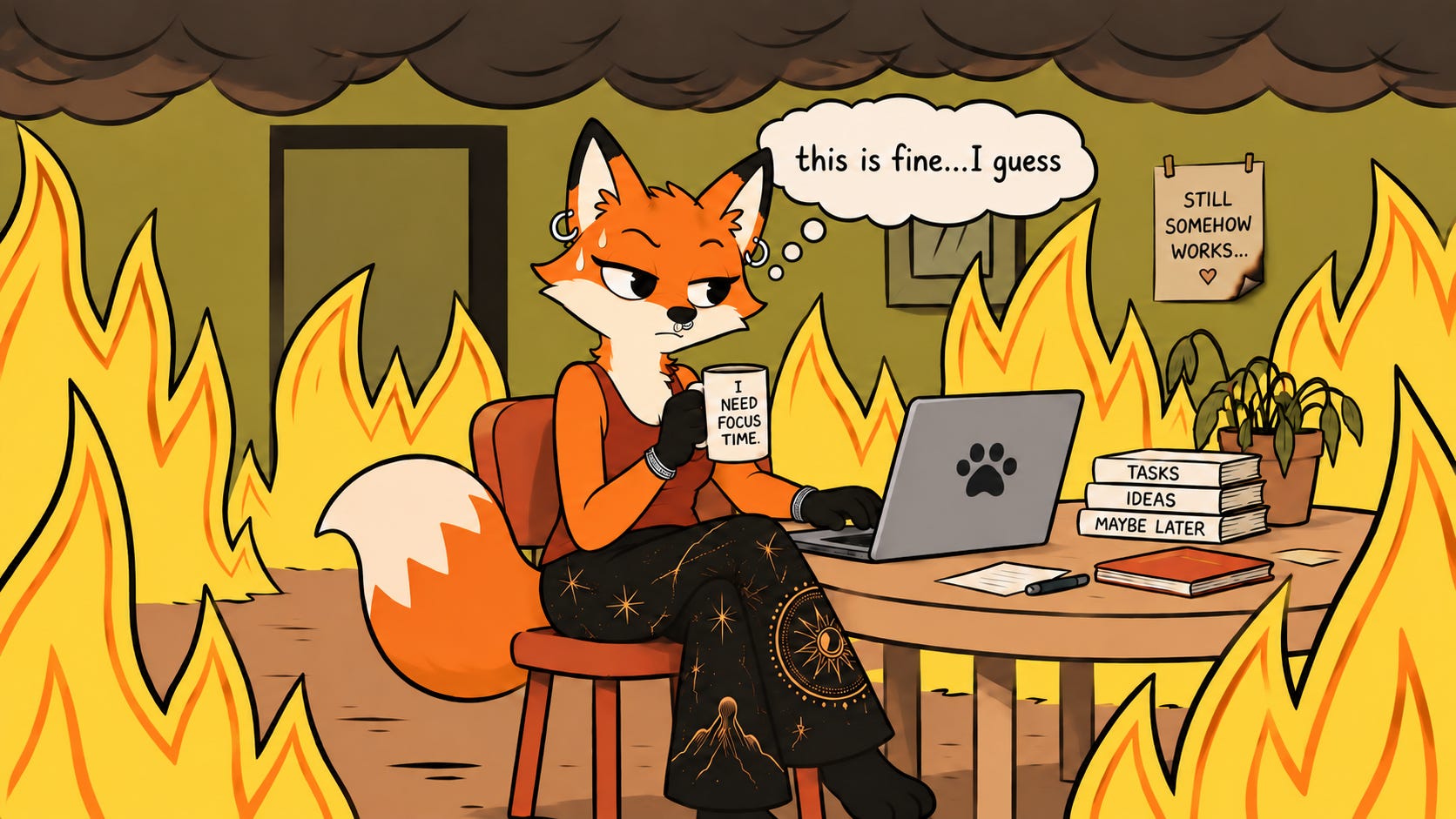
Experiencing burnout myself was a bit of a WTF moment.
No matter how much you read about it or listen to other people talk about it, until you experience it yourself – or watch it unfold in someone you’ve been working with for a long time – it’s really hard to understand what it actually is.
Burnout is an interesting term, actually. It’s not a diagnosis or a disease. In ICD-11 (International Classification of Diseases), it’s classified as a syndrome resulting from chronic workplace stress that hasn’t been successfully managed. And distinguishing it from other conditions isn’t always that straightforward.
So, how did it start in my case?
At one point, I simply couldn’t make myself open my laptop. I just couldn’t.
Of course, it didn’t happen overnight. A whole series of things had led up to it. So make yourself some tea – this is going to be a long story in three parts:
The beginning (this one)
The mess
Life after
The beginning
About a year before I burned out, I started a new job as a Platform Product Manager. The manager was actually one of the main reasons I took the job.
I’d left my previous job partly because of my manager. We were very different in our energy levels and in how we saw the platform and its development – yes, I was in platform product there too. That experience made me realise how important it is for me to be on the same wavelength as my manager.
I know some people are perfectly fine without having any particular connection with their boss. For me, though, it’s important to feel that the person above me is a genuinely more experienced professional – someone I can learn from. And it doesn’t necessarily have to be hard skills. Soft skills are probably even more important to me.
So I was very deliberate about choosing my next manager. And I found one. Yay!
The job itself wasn’t easy. I was stepping into a role that hadn’t existed before, the company was going through massive restructuring, and there was permanent chaos as a result. But who in tech is surprised by chaos these days?
I was there for the person, though, and that inspired me. I loved my team and what we were doing. We had some really cool ideas about how we could automate things and make everything work beautifully.
A few months in, my manager started making it pretty clear that his health wasn’t great and that there was a chance he’d have to go on long-term sick leave.
I got nervous. It would mean taking over the team – and by then I hadn’t been a people manager for about six years and wasn’t exactly eager to become one again – being the interface for all our internal teams and all the vendors behind our external tools, of which we had quite a few, plus ongoing projects, plus hiring, plus a million other things.
Okay, let’s say I could deal with that (maybe). But I’d also have to report to someone whose views were very different from mine, especially when it came to ethical questions. That’s genuinely difficult for me.
And the cherry on top: my probation period wasn’t over yet. In Germany, probation periods are usually six months, and during mine I could still be let go with just two weeks’ notice.
So with all of that going on, I started thinking: okay, what the hell am I supposed to do now?
I started talking to my manager and the manager above him: let’s make a plan. Who takes what? How do we distribute all the responsibilities and projects? Because I had a strong feeling that by default, all of it would simply land on me.
We did make a plan, of course. In Excel. High-end engineering, as you can imagine.
The only problem was that everything the three of us had mapped out hadn’t actually been agreed with anyone else. So in the end, as you can probably guess, I got approximately everything.
At the time, I thought: well, I can handle it. It’s only going to be a month or two.
What all of this eventually turned into – in Part 2: The Mess.